Portrait of Primoz Skraba

Primoz Skraba

  • Professor · School of Mathematical Sciences
    Queen Mary University of London
  • Faculty of Computer and Information Science
    University of Ljubljana

I do applied topology: mostly geometry, algebra, and recently stochastic topology, with a bunch of other things such as algorithms, computational geometry, and machine learning. A long time ago I used to do signal processing. Most of my recent papers are on arXiv or my Google Scholar page; otherwise, see publications.

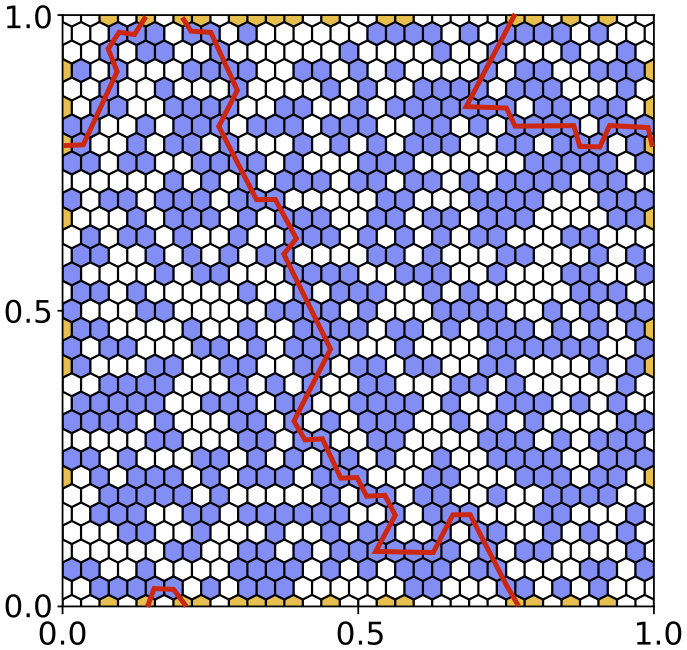
Percolation on a hexagonal lattice on the torus, with a giant cycle highlighted in red

Latest papers

    Research

    I work in applied topology, where algebraic topology meets probability, geometry and computation. These are the main threads, each with a few representative papers.

    Stochastic topology

    What does the topology of a random space look like? I study the homology of random geometric complexes (Poisson and Boolean models, random tilings): the largest persistent cycles, sharp thresholds for the appearance of giant cycles, minimal spanning acycles, and the surprising universality of the \(\text{death}/\text{birth}\) distribution across very different random models.

    Key papers

    Persistence theory

    Persistence diagrams are the central invariant of topological data analysis. I work on their stability, i.e. quantitative control when spaces are only known through samples, and how it relates to classical tools such as exact sequences. I also work on variants of persistence: zigzag, multiparameter, periodic, and Möbius inversion.

    Key papers

    Algorithms

    Persistent homology can be computed efficiently, thanks to the hard work of many people. I am interested in its complexity: algorithms in matrix multiplication time, exploiting sparsity, and computing persistence of infinite periodic structures from finite data.

    Key papers

    Topology, data & machine learning

    Topology as a tool for data: incorporating topological information into neural networks, the Euler characteristic as a cheap but informative descriptor, geometric invariants such as metric magnitude and intrinsic dimension, and earlier work on topological visualization of vector fields and time series.

    Key papers

    Publications

    All papers should be publicly accessible in some version; those without an arXiv or PDF link are open access.

    Teaching

    Notes may be uploaded here from time to time.

    • Programming in Python IIUndergraduate · QMUL
    • Optimisation for Business ProcessesPostgraduate · QMUL
    • Storing, Manipulating, and Visualising DataPostgraduate · QMUL
    • Introduction to Applied TopologyPhD level · London Taught Course Centre
    • Discrete MathematicsUndergraduate · QMUL
    • Calculus / Analysis IUndergraduate · University of Nova Gorica
    • Dynamic SystemsPostgraduate · FAMNIT, University of Primorska
    • Discrete MathematicsUndergraduate · FAMNIT, University of Primorska

    Demos

    Cycle Viewer

    An interactive viewer for persistent cycles, hosted on Streamlit. It can take up to a minute to start if nobody has used it recently.

    Open in new tab
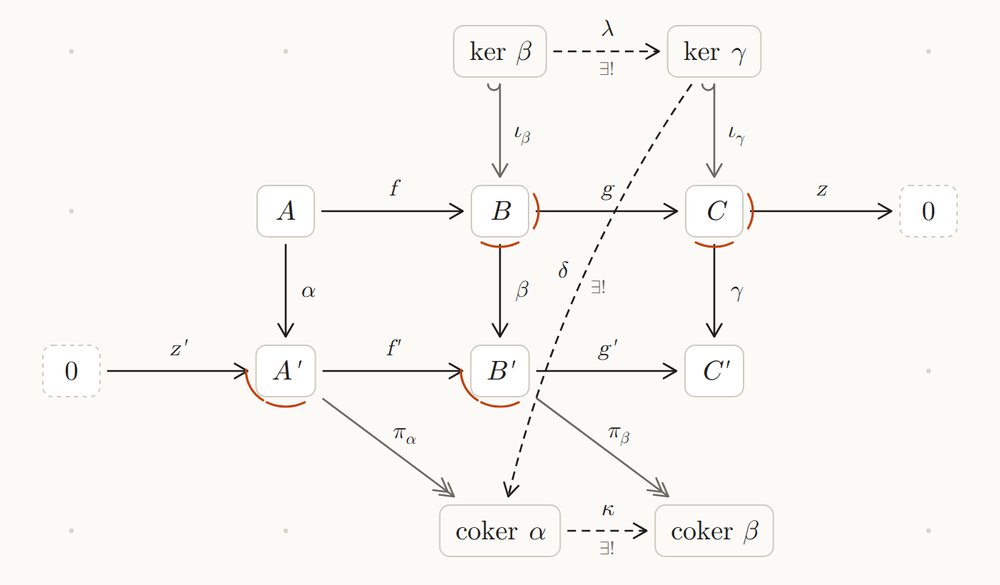
    The snake lemma drawn in the Diagram Chaser: two exact rows, kernels and cokernels of the vertical maps, and the connecting map δ as a dashed arrow

    Persistence Module Diagram Chaser

    Draw commutative diagrams of persistence modules (finitely generated \(k[t]\)-modules) and ask diagram-chase questions: is a map injective, surjective or an isomorphism, is a sequence exact, does an induced map exist, such as the snake lemma’s connecting map? Every positive answer comes with a proof in words and a Lean 4 / Mathlib proof; every negative one with a finite-dimensional counterexample. It runs entirely in the browser.

    Proofs can be checked in Lean 4 Web from the app. If that does not load, download the .lean file or run the app locally; instructions are in the app’s Help and on GitHub.

    Open the Diagram Chaser Source & run locally

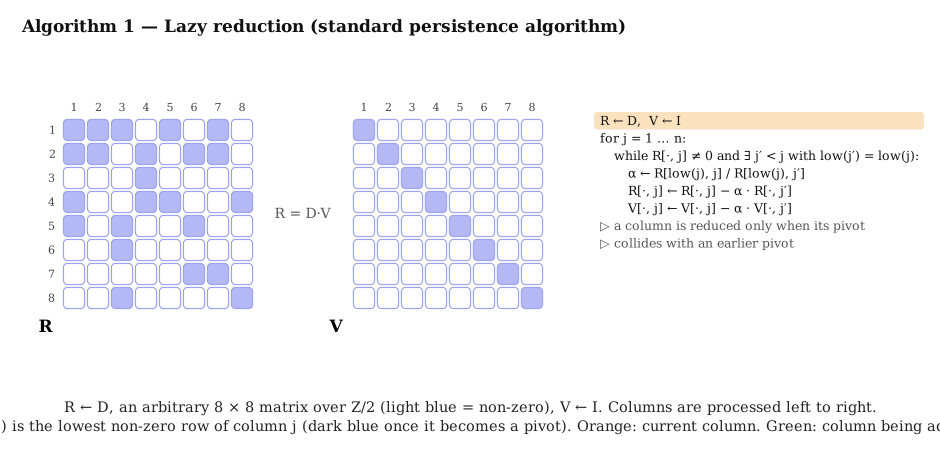
    Animation of the standard persistence algorithm reducing an 8 by 8 boundary matrix column by column

    Persistence algorithms, animated

    Step-by-step animations of six matrix reduction algorithms for persistent homology, all run on the same \(8 \times 8\) matrix: the lazy (standard) and exhaustive reductions, processed column by column or row by row, and the fast column and row algorithms that run in matrix-multiplication time \(O(n^\omega)\).

    Based on D. Morozov and P. Skraba, Persistent (Co)Homology in Matrix Multiplication Time, SoCG 2025.

    Watch the algorithms

    Curriculum Vitae

    Download CV (PDF)

    BibTeX